
No products in the cart.
The History of Balloons
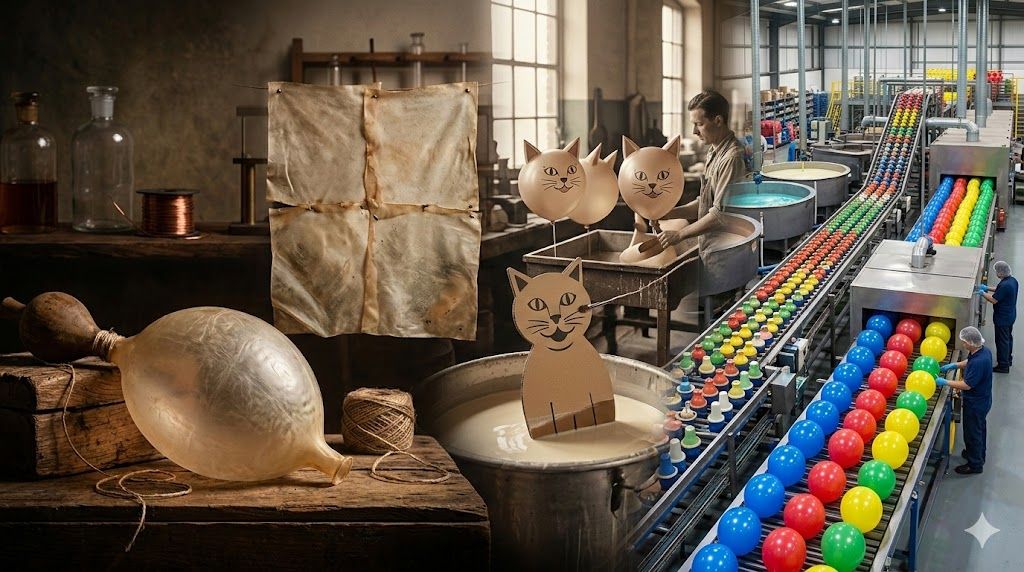
Imagine for a moment the strange, visceral reality of a world before rubber—a world where, if you wanted to hold a pocket of breath in your hands, you had to look toward the macabre. Centuries ago, the “balloon” wasn’t a shimmering orb of latex; it was a ghost of a living creature. To the Aztecs, inflating the dried, prepared intestines of animals was a sacred act of transformation, turning something earthly into a vessel for the divine. In the drafty halls of medieval Europe, the first “balloons” were pig bladders, scrubbed clean and dried until they were translucent and crinkly. There is a haunting, raw intimacy in the thought of a court jester or a curious scientist blowing their own life force into the organs of another being, watching the membrane stretch thin and tight, vibrating with a resonance that felt almost alive. It was a hobby born of bone and blood, a primitive struggle to capture the invisible.
The transition from the organic to the alchemical happened in a flash of scientific obsession in 1824. Michael Faraday, a man whose name is now synonymous with the invisible forces of electromagnetism, was hunched over a laboratory bench at the Royal Institution in London. His fingers were likely stained with the sticky, pungent scent of raw caoutchouc—natural rubber brought from the tropics. Faraday wasn’t trying to create a toy for a child’s birthday; he was a pioneer trying to trap the most elusive elements of the universe. To study the properties of gases like hydrogen, he needed a container that was both airtight and expandable.
He took two circular sheets of this raw, semi-liquid rubber and laid them atop one another. He noticed a peculiar property of the material: when he pressed the edges together, the molecules bonded instantly, creating a permanent, airtight seal. However, because he had rubbed the inner surfaces with flour or dust, the centers remained separate. When he introduced gas into that narrow gap, he felt the birth of a new tactile sensation—the “stretch” that defines so much of our fascination today. He marveled at how the rubber became transparent as it expanded, a shimmering, organic lens into the behavior of matter. But these early rubber balloons were temperamental, leaking their secrets within hours and smelling of the wild, untamed jungle. They were heavy, tacky, and would often melt into a useless puddle if left in the sun, yet they represented the first time humanity had successfully engineered a membrane to mimic the elasticity of life itself.
It was a century of trial and error before the balloon finally found its modern soul in the hands of a desperate, inspired father. In 1931, amidst the suffocating gloom of the Great Depression, Neil Tillotson was working out of a cramped attic with a vat of liquid latex and a dream of durability. The breakthrough didn’t come from a complex blueprint, but from a moment of fatherly love. To please his young daughter, he hand-cut a piece of cardboard into the silhouette of a cat’s head. He dipped that crude profile into the latex, holding his breath as he peeled it away. When he blew air into it, the flat shape transformed into a three-dimensional feline face with two perfect, pointed ears. Those ears were a technical miracle; they proved that latex could be molded into complex, imaginative forms without tearing. He lugged 15,000 of these “Tilly Cat” balloons to a parade in Massachusetts, and the sheer joy they sparked provided the spark to launch an entire industry.
Today, that same spirit of dipping lives on, though the process has evolved into a high-speed ballet of industrial precision. Modern balloons begin their life as a milky sap harvested from the Hevea brasiliensis tree, a natural liquid that is refined and mixed with vibrant pigments. In massive factories, rows of ceramic or metal molds, known as “formers,” are cleaned and dipped into a chemical coagulant that acts as a magnet for the latex. These formers then plunge into deep vats of liquid color, emerging with a perfectly even, cooling skin of rubber. As they travel along the assembly line, brushes roll the bottom edge of the latex to create the “bead” or “lip”—the sturdy ring you use to grip the balloon as you fill it. Finally, they pass through a vulcanizing oven, where heat permanently locks the rubber molecules together, giving the balloon the strength to survive extreme inflation.
There is a profound, almost electric emotion that comes with modern inflation—the tension of the material as it resists, the deepening of the color as the molecules pull apart, and that breathtaking moment when a balloon reaches its limit, shimmering with a precarious, glassy light. In the 1970s, the introduction of Mylar and foil added a new, cold, metallic glamour to the mix, offering a mirror-like perfection that seemed to defy the frailty of life. Yet, for many, the true heart of the experience remains in the latex. It is the smell of the powder, the rhythmic sound of the pump, and the way a three-foot giant balloon feels like a heavy, living weight against your skin. We have moved from the butcher’s shop to the high-end boutique, but the core human desire hasn’t changed. We are still obsessed with the fragile boundary between the air we breathe and the world around us, holding onto a fleeting, beautiful bubble that could vanish in a single, heart-pounding instant.

James is a charismatic storyteller who finds his best inspiration while sipping a bold long black coffee or navigating the neighborhood with his spirited West Highland Scottie dog. Known for his sharp, casual-smart style and an infectious, friendly smile, he balances a polished modern aesthetic with a playful sense of humor. Above all, James is a dedicated aficionado of specialty inflatables, holding a particular affinity for the artistry and scale of Cattex balloons.


Related posts

Whether you are a long-time enthusiast or just starting to explore the joy of balloons, there is something truly special about the variety of latex... Continue reading

Let’s be honest: there is something fundamentally different about a black balloon. While the rest of the world sees balloons as bright, chirpy accessories for... Continue reading

The air in the room felt heavy, charged with that familiar, static-filled anticipation. Resting on the floor was a massive 24-inch clear balloon, a perfect,... Continue reading

Whether you’re setting up for an afternoon of relaxation or just enjoying the presence of your favorite inflatables, the indoor environment can be surprisingly treacherous... Continue reading

It is completely normal to feel a heavy knot of nerves sitting in the pit of your stomach when you think about opening up to... Continue reading
Add comment